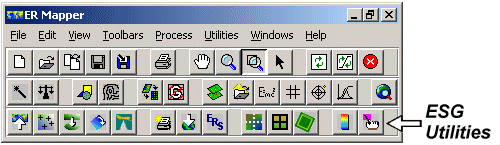
|
The Import Images in Batch wizard lets you import TIFF, BMP, JPEG, ECW, DOQQ, USGS DEM, IMG, LAN, PIX, GIF, Targa and PCX image files to ER Mapper format in batch. This can be useful for converting to ER Mapper Raster Dataset format and batch importing types not supported by raster translators. Output ER Mapper datasets are given the same name as the input file (e.g., image1.tif imports to image1.ers). Features include:
-
Import up to seven files from various locations, all files in a directory, or all files listed in a text file.
-
Automatically transfer geocoding information from World files for TIFF or JPEG images (including rotation) to ER Mapper datasets, and specify datum and projection to assure correct georeferencing in ER Mapper.
-
Batch uncompress ECW files to create ER Mapper Raster files.
-
Automatically calculate statistics for each dataset after import, and a log file to record processing status and system messages.
|

|
The Rectify Images in Batch wizard lets you rectify all images in a directory in batch. Since rectification of large files can take quite a bit of processing time, this lets you take advantage of unattended batch processing. You must first have selected ground control points (GCPs) for each image using the Geocoding Wizard. Features include:
-
Polynomial or Triangulated rectifications, and rectify background (for triangulation)
-
Supports all ER Mapper direct read formats, and saves as GeoTIFF, ECW or ERS format
-
Use rectification parameters for cell size, null value, and resampling already defined in each image (using the Geocoding Wizard), or override them to specify a common set to be used for all rectifications.
-
Append a text string to output filenames to differentiate them from input files of the same name, for example "geocoded."
-
Run interactively, or via a DOS batch (.bat) file at a scheduled time
|

|
The Reproject Images in Batch wizard lets you reproject (map to map transform) all images in a directory in batch. Since reprojection of large files can take quite a bit of processing time, this lets you take advantage of unattended batch processing. Features include:
-
Reproject or datum shift between any datum/projection combination supported by ER Mapper.
-
Supports all ER Mapper direct read formats, and saves as GeoTIFF, ECW or ERS format
-
Define common reprojection parameters for all images, or have the wizard use parameters already defined for each image with the Geocoding Wizard.
-
Specify output datum, map projection, null value, resampling and speed optimization (if defining common parameters).
-
Output images at their input pixel sizes, or resample all output images to a common pixel size.
-
Automatic conversion of cell sizes from meters<->degrees as needed (if reprojecting to or from the GEODETIC projection).
-
Append a text string to output filenames to differentiate them from input files of the same name.
-
Run interactively, or via a DOS batch (.bat) file at a scheduled time
|

|
The Rotate or Resample Images in Batch wizard lets you rotate or resample (change the pixel size) of all images in a directory in batch. Since rotation and resampling of large files can take quite a bit of processing time, this lets you take advantage of unattended batch processing. Features include:
-
Select to rotate all images by a fixed amount, rotate all to the same orientation, or resample the pixel size only.
-
Supports all ER Mapper direct read formats, and saves as GeoTIFF, ECW or ERS format
-
For rotation by fixed amount, select the amount and clockwise or counter-clockwise rotation.
-
Automatically rotate all images to point to the same orientation (north, for example) regardless of the current orientation of each image. (Datasets must be geocoded.)
-
Resample to a different cell size while rotating if desired.
-
Append a text string to output filenames to differentiate them from input files, for example "north" or "50m."
-
Run interactively, or via a DOS batch (.bat) file at a scheduled time
|

|
The Orthorectify Images in Batch wizard lets you orthorectify all images in a directory in batch. Since orthorectification of large files can take quite a bit of processing time, this lets you take advantage of unattended batch processing. You must first have selected ortho parameters and/or GCPs for each image using the Geocoding Wizard. Features include:
-
Orthorectifications using GCPs or Exterior Orientation
-
Supports all ER Mapper direct read formats, and saves as GeoTIFF, ECW or ERS format
-
Use the parameters already defined for each input image, or specify different output resampling, cell size and/or null value to be used for all images
-
Automatically creates output filenames for each image based on the input filename
-
Append a text string to output filenames to differentiate them from input files of the same name, for example "ortho."
-
Run interactively, or via a DOS batch (.bat) file at a scheduled time
|

|
The Print to PC Printer in Batch wizard lets you print multiple algorithms in batch to any PC printer accessible from your computer. This is a batch interface to the "PC Printing" option on the ER Mapper "Print" dialog. This can be handy for batch printing map sheets overnight, printing multiple copies, or other purposes. (This wizard does not print to a file, only a printer.) Features include:
-
Select the PC printer and settings from within the wizard.
-
Select up to seven algorithms from any locations to print, or print all algorithms in a directory.
-
Print multiple copies of each algorithm.
-
Select a "timeout" wait period between prints to let the printer actually print the image before ER Mapper starts to process the next one.
-
Display each algorithm onscreen before printing it.
-
Log file to record selected parameters and processing status.
|

|
The Export Images in Batch wizard lets you export ERS, ECW or ALG images to several different formats in batch. Features include:
-
Export to TIFF/GeoTIFF, JPEG, ERS, ALG, ECW or BIL/HDR image formats.
-
Export all images in a directory, all images listed in a text file, or all images in a mosaic algorithm.
-
Resample the pixel size for exported images (does not apply to ALG exports).
-
Create basic display algorithms for a set of images (for example, apply a 99% clip to all).
-
Export images in TIFF, JPEG, and BIL/HDR to other formats by first creating ERS headers for them (or placing them in a mosaic algorithm).
-
Supports "on-the-fly" reprojected algorithms (except to/from GEODETIC) to export images in a different projection.
-
Create World files for exported TIFF or JPEG images (including rotation terms).
-
Export TIFFs up to 2GB in greyscale, RGB, 256-color or multi-band formats (8- or 16-bit).
-
Run interactively, or via a DOS batch (.bat) file at a scheduled time
|

|
The Create or Edit ERS Files in Batch wizard lets you edit a directory of ER Mapper header (ERS) files in batch, or create ERS headers for image files with World or TAB metadata files, or GeoTIFF files. This is an alternative to editing ERS files one at a time through ER Mapper’s Dataset Header Editor, and lets you directly use TIFF, JPEG or BMP images with World or TAB files in ER Mapper without importing them (by creating ERS headers). Features include:
-
Edit the current datum, projection, null cell value or dataset rotation value for group of ERS files in batch.
-
Change the Units setting to Meters or Feet, and change cell sizes in feet to the their meter-equivalent values.
-
Create ERS files containing correct geofererencing information for TIFF, JPEG or BMP images with World or TAB files without manual "one at a time" header editing.
-
Backup each ERS file to a backup copy before creating the edited versions, and restore the previous set of ERS files if desired.
|

|
The Cut Algorithm into Tiles wizard lets you subset (or "cut") a geocoded algorithm into tiles of standard geographic sizes (1000 meters, 7.5 minutes, etc.), numbers of pixels (512 by 512, etc.), number of tiles (5 by 5, etc.) or using text file with tile names and extents. This can be handy for subsetting a large dataset or mosaic, or creating a series of equal size images for map sheets. Features include:
-
Select tile sizes from standard menu lists, or enter your own custom X and Y sizes or number of tiles.
-
Export image tiles to TIFF/GeoTIFF, JPEG, ERS, ALG, ECW or BIL/HDR image formats.
-
Automatic file naming of output tiles (row & column number, upper-left Easting/Northing coordinate, or tile number in sequence).
-
Use a text file with names and extents to help tile irregular areas or when specific filenames are required.
-
Create World files for exported TIFF or JPEG images.
-
Prefix each tile file name with a text string if desired.
-
Specify adjacent tiles to adjoin exactly, or overlap by a fixed amount (for example 50 meters).
-
Supports "on-the-fly" reprojected algorithms (except to/from GEODETIC) to export tiles in a different projection.
-
Automatically trims tiles in the last row or column to avoid empty areas, or areas outside the extents of the input algorithm.
-
Preview the number of tiles your selected values would create to evaluate different tile sizes.
|

|
The Create Mosaic Index Map wizard lets you create an ER Mapper-format vector dataset showing the extents and filename of each image in a mosaic algorithm. This can be useful to locate an image quickly within a large mosaic, or to create an index map sheet for use in map composition or delivery with tiled images. The wizard creates a rectangular "index box" polygon drawn to the upper-left and lower-right extents of each image. Features include:
-
Build an index map of all image files loaded into a specific layer type (Pseudo, Red, Intensity, etc.) in the algorithm.
-
Print the image filename inside each index box if desired.
-
Assign a single color to all index boxes and text, or cycle through a set of rainbow colors (useful to see extents of highly overlapping images).
-
Set index box line thickness, and filename font, size and position (upper-left corner or centered).
-
For rainbow color boxes, select outline (hollow) boxes or shade patterns.
-
Automatically export the index map to Shapefile or DXF vector format.
|

|
The Create Rotated Clip Regions wizard lets you create custom clip regions for a set of images in batch that mask out a specific percentage of the outer image area. The regions can also be rotated to aid mosaicking of images acquired on oblique (not north-south) flight lines. Features include:
-
Specify different X (horizontal) and Y (vertical) percentages for clipping.
-
Specify X and Y offsets to shift the region center to best fit images.
-
Rotate clip regions to help fit them better on image sets acquired with oblique flight lines (i.e., not directly north or south).
-
Preview the settings on any image, and adjust them as many times as needed to optimize the clip percentage and rotation.
-
Specify the region name to used for all images.
-
Automatically create a vector (ERV) index map showing the locations and overlap of all regions.
-
Each image filename is encoded as the text attribute of it's corresponding polygon in the ERV index map vector file.
|

|
The Create Color Table wizard lets you interactively create ER Mapper color tables. Features include:
-
Select up to seven colors graphically using the standard ER Mapper color chooser buttons.
-
Specify either smooth interpolation between the selected colors, or create "steps" with blocks of color.
-
Automatically saves the new color table in ER Mapper's color table directory (/lut).
-
Create several color tables in one run.
|

|
The Run Algorithm Slideshow wizard lets you display all algorithms in a directory one after another, so you can create your own ER Mapper "slideshows." This is handy for self-running demos at tradeshows, or easily cycling through a series of algorithms during a presentation. Features include:
-
Automatic (unattended) or manual control.
-
Number of cycles to run, time between images and image window size (for automatic control).
-
Start, move ahead or move back one slide (algorithm) for manual control.
-
Automatically shapes window size/aspect to match the algorithm (no empty window areas).
-
Preferences to remember the algorithm directory and other settings from the last time the wizard was run.
-
Pop-up status dialog to show current algorithm name.
|